Showing posts with label Cataloguing. Show all posts

Monday, 7 September 2026

Ten Tips to Create an Organised Collection

Are you a disorganised mess? Do you have model horses coming out of your ears? Is there a rosette in every corner and a pile of certificates on every surface? Then are you sure you're not me? Ha ha ha just joking everything is super *cough* organised here. Well today we will be following the wise words of do as I say and not as I do and I am going to be sharing ten tips to keep your collection organised.

1. Create a Spreadsheet

The first step to an organised collection is an organised spreadsheet. I have written lots of guides on how to create a spreadsheet to catalogue your models (there's even a YouTube video if you are one of those people that prefers your tutorials to move) so I'm not going to go back over this in detail here but what I will do is list all the columns I recommend you have:

Original Finish/CTF
  • Stable name
  • Show name
  • Breed
  • Colour
  • Gender
  • Scale
  • Make
  • Model number
  • Model name
  • Mould
  • Year produced
  • Run number
  • Face markings
  • Leg markings
  • Finish
  • Year purchased
  • Purchase amount
  • Value
  • Sire
  • Dam
  • ID number
  • Additional items (e.g. a headcollar the model came with)
  • Location
  • BMECS/NAN qualification (column for each year)
  • Show points
  • Shows attended
  • Average points
Custom Finish/AR
  • Stable name
  • Show Name
  • Breed
  • Colour
  • Gender
  • Scale
  • Make
  • Artist
  • Sculptor (ARC only)
  • Mould
  • Year painted
  • Face markings
  • Leg markings
  • Year purchased
  • Purchase amount
  • Value
  • Sire
  • Dam
  • ID number
  • Location
  • BMECS/NAN qualification (column for each year)
  • Show points
  • Shows attended
  • Average points
I recommend having two separate sets of show points, one for breed and one for workmanship.


2. Catalogue models as they arrive

Stay. On. Top. Of. Your. Cataloguing.

As models arrive make sure they are photographed and catalogued. That way you always know what is in your collection. Also, remember your spreadsheet is also there for insurance purposes should the worst happen, so it is important that new £1000 artist resin gets put on!


3. Use unique ID codes

Give each of your models a unique ID code that can be used to identify them. This is also helpful if this is required for shows and can match the one you use for shows. You can put this ID code on their tag and also use it as the file name under a folder on your computer where you are going to keep one photo of each horse for identification purposes.


4. Write up results the day after the show

Staying on top of show results is so important. Did I write up some show results from a show in October last week? Is it currently September of the following year? Yes. Was this good practice? Absolutely not. Don't be me, be a good model horse collector.

Make a point of allocating time either on the evening after a show or the day after to write up the results. Then file them. Keeping on top of it won't make it feel overwhelming and will mean you have a good consistent record of each horse's winnings.

5. File certificates

File. Your. Certificates. There are two ways you can do this. You could have a file for each year and just throw them all in. This is quick and easy to do but has the disadvantage that if you want to sell that model you cannot easily grab their show results to give to the new owner.

The alternative is to have a wallet for each model in an A4 folder. You can organise them by ID number or alphabetically (I prefer ID number as I don't have to move things around, just add them at the end). In each wallet you can have a slip of paper with their photograph and basic details on (optional) or just a sticker with their ID number in the corner. Put all of their certificates into the folder after each show.

6. Keep models in congas

This seems obvious but it will honestly make your life so much easier if models of the same type are kept together. Keeping models in congas doesn't just look aesthetically pleasing it also helps you to easily find models when you need to pack them for shows.


7. Use a storage reference system

If you are having to store your models in boxes rather than shelves then make sure you have a storage reference system so you know where everyone is. Number each box and keep a list of which horses are in that box. You can add this to your spreadsheet but could also print it out and put it on the lid of the box. You can get these clever QR code stickers now that you can stick on boxes and scan to see what's in them, I've not tried them but I get the adverts all the time, so maybe you could try that and feedback to say whether they are actually any good?

8. Organise your tack and accessories

Organisation isn't just about your horses, it is about your tack and accessories as well. Keep sets in their own boxes with clear labels so you know exactly what is in each box. With spare pieces keep them organised by type, for example I have a box for English Tack as well as having each of my English tack sets in separate boxes. When you go to shows you can just take the boxes you need. You can even use slightly larger boxes to make sure you have the doll and props stored with the correct tack set as well.

Finally, catalogue your tack, dolls and props! If you're spending £200 on a custom doll you want that catalogued, it has value and you will want to make sure it is all in order for insurance purposes, in case the worst happens.

9. Write results down at shows

You're at a show, you're busy, you're running around like a headless chicken because for some reason the show host has decided to put workmanship and custom finish on at the same time and then has asked you to judge the OF section at the same time as well?!??! Anyway. Despite this chaos make sure you write down your results, because although you think you'll remember honestly you are not going to remember who got what placing. If you don't have time to write names on the back of certificates add a column to your show list spreadsheet for placings, then you just need to write down a number very quickly. Keep on top of this and it will save you having to go through a million pictures when you get home to find out who placed where.

10. Back. Everything. Up

No system is fool proof. Everything can fail. So make sure you have a backup of at least your spreadsheet of all your models. As a general rule everything that matters should exist in three formats (1) Digitally saved to a desktop (2) Digitally saved to the Cloud (3) Physically. Regularly back up the important desktop files to the cloud or download them from the cloud onto a hard drive. You should also regularly back up your computer to an external hard drive. I also recommend having a physical backup. Print out your spreadsheet, get physical copies of your photos. We rely so much on technology we forget that it could all be wiped out in an instant. That is much harder to do with physical items. But physical items can also be wiped out, so make sure there is a digital backup in case of house fires or similar!

And on that note, I'm going to back up my Massive Horse Spreadsheet because I haven't done it in ages!

What tips do you have for keeping your collection organised? I'd love to see them below.

Monday, 9 January 2023

Evaluating Your Collection

 It's a new year and with a new year comes a bit of a stock take. I do think it's important at times to go over what you own and start to think about where there are gaps and where your focus should be for the next year. This is particularly true if, like me, you're a regular shower who doesn't really have any specialism and just likes to have all the pretty things!

The main focus of this post is going to be evaluating your collection with regards to having a well balanced show string, but this can be used in lots of other ways too :)

So here is my guide to start evaluating your collection.

Step 1: Cataloguing

If you haven't catalogued your collection then this is your cue to start. You need to catalogue your collection from day one. On a very basic level if your house burns down and you don't know what you have you won't be able to claim on the insurance, so please catalogue!

There are tonnes of different ways you can go about doing this (and I've already written loads of tutorials on it) but here are the three main ways:

1. Paper catalogue
2. Spreadsheet
3. Specialist software

Some people do still like to do a paper catalogue, either in a binder, notebook or one of the specialist model horse cataloguing planners. This is a lovely way to do it and looks beautiful but it can be time consuming, it is also not much help if it burns with your house (you should have a fire proof box in your house where you can keep important documents, if you are paper cataloguing and don't have one, get one).

A spreadsheet (either excel, sheets or similar) is probably the most popular option. I've done a tutorial on it here. 

Finally you can use specialist software. There are a variety of different programmes out there designed to do this. The two I've used are MyModelHorse Database and OMHPS (this is a photoshowing database but can also be used for cataloguing if you have less than 2,000 models). I did also use one years ago that came on an actual disk (so vintage) but I cannot remember the name of it!

Once you have your models catalogued you can move on to data collection.

Step 2: Know what you've got

Now you need to know what you've got. There are various ways to do this but this is my super duper not technical simple method.

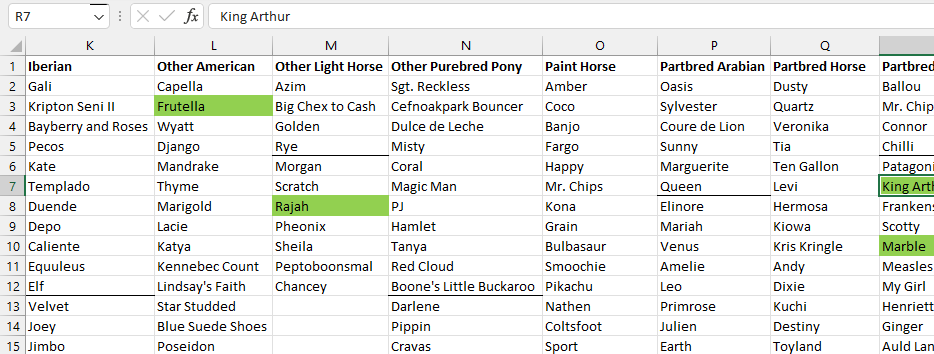
I use a blank excel spreadsheet. Along the bottom are tabs for different finishes. On each sheet is a column for the different show classes like so:


Underneath each one is a list of all the horses that go into that class. That way I can clearly see who I have for each class. I also use this to help pick horses for showing. You can also use filters on your actual catalogue to help with this.

As an aside the green squares are BMECS qualified horses for 23/24/25.

Step 3: Where are the gaps?

Now the next question is, where are the gaps. Above is an extract from my OF sheet. Not many gaps there. Now take a look at ARC:


Immediately you'll note that some columns aren't even there. I don't own a single ARC Paint Horse for example. You can also see some have WAY MORE horses than others. It is really no surprise that I own thousands of fantasy/decorators and then hardly any realistic models.

Seeing where I have gaps can help me to think about what I might want to focus on creating for the next year. This is especially useful if you have like 100 blank resins *maybe more cough*. So in terms of my painting for this year I am definitely going to increase my stock horses and I could also do with a few more British Native. I should probably not paint anymore fantasy or decorator models for a while!

Step 4: Where can you make cuts (if you want to)?

This step is totally optional. But if you do want to cut down your collection you could start by making cuts where you simply have too many horses to realistically ever show. Using this spreadsheet I can see that I have 156 OF Fantasy/Decorator horses. The reality is it would take years for me to show them all so most never go out. If I want to make cuts this is probably the best place to do it (I won't though, you can prise my decorators out of my cold dead hands).

Step 5: Where could you introduce new blood

The final step is to think about where new blood could be introduced. It may be that yes you have ten very nice CM Arabians, but actually they are all 10 years old and don't really do much anymore. Maybe, looking at that, a focus for this year could be adding some new ones. If you also cross reference with your workmanship tab you could focus down even more by trying to fill gaps in colour as well as breed.

So there we go! Collecting evaluated and stock take done. Now to start planning some shopping for the new year :D

Tuesday, 4 January 2022

My Favourite Websites: Schleich Wiki

Over the years I've shared lots of websites with y'all that are invaluable to any model horse collector. Today I received an email from a customer asking about how they could keep track of their Schleich collection, so in response to that I thought I would share one of my favourite resources, the Schleich Wiki page!

Toy Animal Wiki is a great resource record for the different CTF toy brands. But the one that I think we all find most useful is the Schleich page.

https://toyanimal.info/wiki/Schleich_Horses

The website isn't the best if you don't have some idea of what the horse you are looking for is. It is better for finding information about the model in order to put it in your records. It gives the years produced and also the product code which is really useful!

It is also missing some information here and there but generally speaking is very useful and up to date.

If you are looking to ID a model I recommend that you start by either Googling an approximation of what you think it looks like (is it a Holsteiner? a Lipizzaner? a Shire?) or you use this website: http://www.toydreamer.com.au/schleich1.asp?toytype=knights to help you find the model you are looking for.

I hope that proves helpful for my fellow Schleich collectors :) Remember you can also download a model horse spreadsheet from our website here: https://www.chestnutridge.co.uk/free-downloads.html#/


Sunday, 26 April 2020

Seminar #3 - Cataloguing Models - Friday 1st May 2020

I hope you have been enjoying our seminar series and are learning lots about model horses and what to do with them. Whether you are an experienced hobbyist or new to the hobby each seminar has something for you.

Our next seminar will show you how to effectively catalogue your model horses.

It is important to catalogue your collection accurately for a variety of reasons, we will discuss these in the seminar!

It will show you how to:

  • Put together a spreadsheet
  • Use functions like filters and formulas to get the most out of your spreadsheet
  • Basics about identifying & valuing models (we will do this in more detail in a later seminar)
If you want to take part we recommend having your computer open with Excel (Google Sheets or similar will also work but you may find the functionality a bit limited) so you can make your spreadsheet as we go!


Seminar Date: 1st May 2020

Seminar Time: 13.00 BST (UK Time)


Finally all past seminars are now uploaded to our YouTube channel, so you can watch them when you want :)


See you guys Friday!

Monday, 22 October 2018

Collector's Resources

I thought for today's post I would share a few websites that are invaluable to the model horse collector. Most of these websites are sites that give you information for cataloguing your models.

If you haven't already catalogued your collection then this is definitely something you need to think about doing. There are several reasons for this. Firstly it will help you remember who is who! It seems like a little thing but as your collection grows you may lose track of names, you can't be expected to remember two names for hundreds of models! A catalogue will help you quickly identify a model. Secondly it is important for insurance purposes. Many insurers will ask for this if you have specialist insurance in particular and it is important to keep an accurate up to date catalogue of your collection including values. Finally (and on a slightly morbid note) it is important for your family to know what you have, what it is and what it is worth for when you pass away. This will make sure that if they choose to sell they get a good price for your models and also that any future owners get things such as show results.

The hardest part of cataloguing is often identifying exactly what you own and how much it is worth, so I've put together this list of handy websites to help you identify each model horse in your collection.

But first a note about value. The most important thing to remember when valuing is that old mantra of "something is only worth what people are willing to pay". I find the easiest way to get an idea of a model's value is to look at how much that model has sold for for other people (of course this is really only applicable for OFs but this post is mainly geared towards that). To do this visit eBay (I use ebay.com rather than .co.uk as more Breyers sell through this) and do a search for the item name or number. For example "Breyer Brass Hat". Then on the left hand side click the little box titled "completed items":


Now look for items where the price is green. This will give you an idea of the average selling price for that item. Obviously you need to adjust a bit depending on the condition of your model but this is a great way to start valuing things. Looking at it I can see that this model is selling for between $20-40.

OK so onto our resource link! Obviously these are all external links and I accept no responsibility for their content. At the time of posting I didn't die when I clicked on them but you do so at your own risk!

General


If you aren't sure what something is general searches on MH$P can help you to identify the model you have. You can also use it to help get an approximate value if the eBay method isn't working for you.

Model Horse Gallery - http://www.modelhorsegallery.info/

This contains information about a huge range of makes and models. Great to delve into if you really aren't sure what something is!

OF Plastic


This website is good for identifying Hartland horses.

Identify Your Breyer - http://identifyyourbreyer.com/

One of the most comprehensive lists of Breyer models in an easy to use format. Invaluable for looking up information such as release dates, product numbers and product names.

Stone Horse Ref - http://www.stonehorseref.com/

This website is good for identifying older Peter Stone models.

China & Resin


This is a sales site but is really helpful in trying to identify Beswick model horses as it includes product names and numbers.

CTF Models


This is quite useful for identifying older G1 My Little Ponies


A rather old website but still good for helping you identify Grand Champion model horses.


This is a rather old website but it is really helpful if you want to ID My Beautiful Horse models. Again I've used it successfully for charity shop finds.

Strawberry Reef - http://www.strawberryreef.com/

This is a great site for identifying My Little Ponies. It can take some time to search but I've managed to ID all my random charity shop finds using it!


This is an Australian sales website but it has an incredibly comprehensive list of Schleich model horses. It contains information such as product name, number and release dates. I've used it to catalogue all my Schleich models.

I hope that helps you on your quest to identify your model horses and start cataloguing your collection. If you have any questions or want to recommend a website that you think will help others drop a comment below.